Wednesday, June 11, 2014

Kaunas


Last weekend we took a bus to Lithuania’s second city, former national capital, and epicenter of the national basketball craze:  Kaunas.  It turns out that there is a lot to see in Kaunas, much more than we could have squeezed in over a weekend.  But we had a great time that included a quick trip to Rumšiškes, about which we will have more to say in a day or two. 

We spent two nights at the Daugirdas, a hotel in the city’s old town, about a block away from the town hall square, or Rotušės Aikštė, where we were reminded of something we learned during previous visits to such cities as Rome and Prague:  Saturday is wedding day in Europe, and weddings usually involve parallel ceremonies—one at city hall (see photo at the top of this post) and another at a nearby church.  These events typically are scheduled back-to-back, which means that on Saturdays the town hall square is chock-a-block with wedding parties hanging around waiting for the call, traipsing off in the direction of a neighborhood church, or folding themselves into horse-drawn carriages, vintage automobiles, or (in the case of the bride below), stretch limousines.  It’s pretty picturesque.  How could one not be charmed by peripatetic brides, grooms, and their attendants on their matrimonial rounds on a gorgeous sunny day in old town Kaunas?


We visited Kaunas Castle (see photo below).
 

Jane climbed creaky stairs sans handrail up to the top of the castle tower, while Ken, ever reluctant to abandon terra firma, amused himself by taking selfies on the castle grounds (see photo below).


We also enjoyed hanging around in the watering holes on Vilniaus Street, which is the name of the pedestrian district in Kaunas, as it is also in Siauliai.


One of the truly fascinating things about Kaunas is that cartographically, it is quite reminiscent of Pittsburgh, though its hills are much more modest, and of course maps are two-dimensional representations of three-dimensional realities.  As in Pittsburgh, two rivers meet at Kaunas, the Neris and the Nemunas, and at their confluence a “third” river is formed (see photo below), though in the case of Kaunas it is considered a continuation of the Nemunas. 
 

On the south shore of the Nemunas, near “the point” where the rivers meet, there is a funicular railroad that leads to a hilltop overlook, which is reminiscent of the vantage point on Mount Washington where the young George Washington saw at once the military value of the site.  It was in fact crucial to control of the Ohio Country, and was fought over by the English and French, and then fortified by the newly independent Americans in the eighteenth century.  Kaunas is, simply, Pittsburgh without the dramatic topography, yesterday's smoke, and today’s spectacular skyline.

We didn’t do Kaunas justice, but we did have one extraordinary experience, one that Jane and I will never forget.  Thanks to Ken’s Šiauliai University colleague, Aistė Lazauskienė, who lives in Kaunas, we were able to visit the AB Underground Printing House, which reminded us of the marvelous German film, The Lives of Others, which won the Academy Award for Best Foreign Language Film in 2006. 

We were shown around the eerie site by the wife of Vytautas Andziulis, the typesetter who was one of two partners in the clandestine publishing operation.  Astoundingly, at the end of our tour we were joined by Mr. Andziulis himself, who still lives in the house, and who took the occasion to complain about U.S. foreign policy--though in terms polite enough to spare our feelings, and those of our translator, I think.  This museum is a gem, though it is hard to find, and almost as hard to research.  Here is the entry from the “In Your Pocket” guide: 

Founded and run by Vytautas Andziulis (b. 1930) and Juozas Bacevičius (1918-1995), the AB Underground Printing House (the title comes from the first letters of Vytautas and Juozas' family names) operated at great risk during the last decade of the Soviet occupation of Lithuania three metres under the ground in Andziulis' garden on the outskirts of Kaunas. Dug by hand between 1978 and 1980 and reinforced with sturdy concrete walls, during its lifespan the printing house published 23 titles dealing with subjects ranging from Lithuanian history to religion and poetry, all on a hand-cranked machine built from miscellaneous spare parts gathered by Andziulis who was at the time a professional printer. Now part of the Vytautas the Great Military Museum, the printing house has been preserved and can be visited by prior arrangement. Set in the small village of Saliai some 10km north of the city centre, visitors can view the old printing house, which was and that remains hidden under a greenhouse as well as a museum dedicated to the place and to resistance printing in general. Easiest reached by car or possibly bicycle, the museum is more or less off the public transport route entirely. The N°21 city bus to the Mega shopping centre is the best option. Running from the Kauno Pilis stop close to Old Town to the Mega shopping centre, get off at the Šiaurinio Aplinkkelio Tiltas stop and keep walking out of the city with the river on your right until you reach the outskirts of Saliai. A signpost marked Pogrindžio Spaustuvė Muziejus takes you off the main road. At the fork a little further on, keep to the right and look for the small car park of the left. The N°21 also runs a couple of services in the afternoon to Saliai itself, in which case you need to double back on yourself and keep an eye out for the museum sign. Everything at the museum and printing house is labelled in Lithuanian only and nobody speaks English. Taking somebody along who can translate is not only recommended but more or less essential. 

Entrance free.

As luck would have it, as we approached the hidden crawlway in the greenhouse, the battery in my camera announced that it needed re-charging.  So I have no photos to share, alas.
 

Tuesday, June 10, 2014

The American Corner


Jane here.  This will be my one and only contribution to "Baltic Avenue."  Please read on!

One of the amazing things about this semester is that George Washington University has allowed me to telecommute—from Šiauliai to Foggy Bottom—two days per week, usually Tuesdays and Wednesdays.  This has kept me busy, but those of you who know me also know that I am not one to sit still for long.  So at the suggestion of the U.S. Embassy staff in Vilnius, I became a volunteer in the “American Corner” at the Povilo Višinskio Siauliai Public Library, a five-minute walk from our flat in the city center.
 

The American Corner--the only one in Lithuania, though there are two in Latvia and three in Estonia--celebrates all things American, maintaining a small but satisfying lending library of books in English, as well as English-language movies and magazines.  Among other things, the American Corner hosts the "English Club," which meets weekly on Mondays from 5:00-7:00 p.m.  The Club's agenda varies:  one week might be devoted to talking about American customs during Mardi Gras and Shrove Tuesday, while another might feature a showing of "All the President's Men," followed by a discussion of how presidential elections are funded in the U.S.  A particularly challenging program included a viewing of "Imitation of Life," followed by a frank conversation about race relations--past and present--in America.  At other times members would discuss their recent travels to other countries and what they saw and learned.

Membership in the 3-year-old English Club is open to anyone who wishes to improve his or her English and to learn more about others and about America.  The majority of members are Siauliai residents--many of whom were born in the city and have lived here all their lives.  Of that group, many are retired, but some are young working adults, and one is a former member of the Lithuanian parliament and a founding father of the independent Lithuania dating from 1990.  And then there are students--mostly from Turkey--and young adults doing internships, from Armenia and Georgia.  Please see the group photo above.   

The intrepid leader of this friendly crew is Roma, shown below on the left, whose enthusiasm and personal warmth bring English Club members back week after week.  Her talented colleague is Jolanta, below on the right, a middle school teacher whose great skill in infusing the Club's activities with fun fosters a strong sense of collegiality.


The Club has never before had an American member, so I was a bit of a welcome novelty.  Over the months, I answered many, many questions about the U.S., and connected particularly with members having children living in America or children traveling in America.
 
 
Last night the group feted me and the several delightful departing Turkish students at Juonė Pastuogė, a Birchmere-like music hall within spitting distance of our flat (please see below).  Each member was encouraged to offer a toast--in English, of course-- and those who did so more or less successfully were given "10 points" of public recognition and a round of applause. And I offered my own comments on my great good fortune in coming to know them all and to learn from them about their beautiful country, their kind and colorful culture, their heart-breaking past, and their promising future.

Ačiū, English Club, Roma and Jolanta, for welcoming me into your wonderful fold!  I will miss you all!


Monday, June 9, 2014

Auksuciai Model Farm and Forest Center


Last time I published a post on Jonas Šliūpas and his son, who together span over 150 years of Lithuanian history.  Šliūpas père, born in 1861, was a medical doctor and hero of the early national period.  Šliūpas fils, born in 1930, is a Californian whose professional life has been based on his knowledge of irrigation, drainage, and water resources engineering, and whose current project is aimed at improving agricultural practices in Lithuania.  Here’s how his activities are described on the VilNews website:

The US non-profit Auksuciai Foundation was established to help small scale Lithuanian farmers become more self-sufficient and competitive in a free market economy. A primary way that Foundation is working to achieve this goal is through support and advisory involvement with a model farm facility (the Auksuciai Farm and Forest Center, a Lithuanian non-profit), that allows participants from academia, business, government, and the farm community to share information and technology regarding environmentally sound management (including forests) and commercial agricultural production practices. Additionally, the Foundation organizes farmer-to-farmer and agricultural student exchanges; farmer mentoring; and in country workshops between the agricultural and forest communities of the U.S. and Lithuania.

Last Thursday, the model farm near Kursenai (see photo at the top of this post) held its annual field day (lauko diena).  As the patron saint of the Auksuciai Foundation, Vytautas Šliūpas presided, along with Professor Cal Qualset of the University of California, Davis.  Kicking off the program was Mindaugas Kuklierius, Lithuania’s vice-minister of agriculture, and Antanas A. Mazilauskas, rector of Aleksandras Stulginskis University in Kaunas.  The photo below shows Mr. Šliūpas to the left, introducing the vice-minister in the orange shirt. 


One of my colleagues, Dr. Jonas Jasaitis (pictured below), has been part of the Auksuciai Foundation’s brain trust from its inception, and he has built useful bridges between the model farm and the Rural Development Center that he runs at Šiauliai University.  Dr. Jasaitis invited me to tag along and contribute what I could to the field day proceedings.  


Three researchers at the Auksuciai Farm and Forestry Center, including the aforementioned Cal Qualset, delivered a most interesting paper on the commercial potential of asparagus farming for small farmers in Lithuania.  

After Jonas and I (pictured together below) delivered our papers, we engaged in serious and informal conversation with our colleagues, among whom were both academics and farmers.  It was an exhilarating experience.  I felt transported backwards in time to the founding generation of a free Lithuania.


Saturday, June 7, 2014

Vytautas Šliūpas


Way back on March 18, 2014, I published a post having to do with Šiauliai street names.  Here’s a link.  I wasn’t very explicit about it at the time, but one of the cruelest ironies in that sordid history is the way that the Soviet occupation government dropped Jonas Šliūpo gatvė in favor of I. Michurin gatvė, Šliūpas having been the most humane of scientists, and Michurin having been a complete fraud.  He, Michurin, was the man who convinced the Soviet Union to entrust its agriculture policy to rank amateurs who rejected the basic tenets of Mendelian genetics.  It proved not a good idea.

I was aware that the man for whom Jonas Šliūpo gatvė was named, Jonas Šliūpas, was one of the intellectuals who gave substance to the Lithuanian national movement at the turn of the twentieth century—a hero celebrated enough to have earned postage-stamp treatment (see image below) in the independent Lithuanian Republic that emerged out of the ashes of World War I.  I knew that Šliūpas was a medical doctor, and at some point I was aware that his papers are collected in the Šiauliai University Library.  Still, I didn’t know enough about Šliūpas to keep from confusing him with other national leaders of that period.  And I had no idea that Šliūpas spent much of his life in the United States—specifically, as a practicing physician in the anthracite coal regions of northeast Pennsylvania.  The point is, to the extent that I thought of Šliūpas at all, I thought of him as a 19th-century man. 


That’s why it never occurred to me that Jonas Šliūpas could have been one of the heroes of the resistance to the Nazi Occupation that became a juggernaut after the German occupation of 1940.  And yet it turns out that, as mayor of Palanga (see my post on our trip to Palanga here), Šliūpas gave the Nazi authorities no end of grief about the policies they were employing to effect the Jewish Holocaust.  Šliūpas’s house there is maintained as a shrine (see photo below).


I hope you can endure another longish aside.  One of the regular loiterers here on Baltic Avenue, our friend Michael Kasler, has asked several times about my frequent references to the vanished community of Lithuanian Jews—Litwacks, who contributed so much to the cultural distinctiveness of this country during the tsarist era, and then again in the interwar period of the twentieth century.  Have the Lithuanians, Michael has asked, attempted to sweep the Jewish Holocaust, which claimed roughly 300,000 lives in this tormented land, under the national rug?  My answer has been that the Soviets, for their own reasons, were good at implying that the Nazis found willing executioners among ethnic Lithuanians, and that therefore they and their progeny must bear a portion of the guilt.  (By managing your affairs, we are saving you from your own fascist proclivities, is the suggestion.  We are hearing a version of it again in this part of the world).  But those stories are dramatically contradicted by the saga of Jonas Šliūpas and many other profiles in courage.

As mayor of Palanga, Šliūpas, at great personal risk, challenged the Nazi’s policies vis-à-vis “the Jewish question.”  In fact, he was contentious enough that the Nazis eventually felt they had to replace him as mayor.  It says something about Šliūpas’s commitment to even-handed justice that despite his difficulties with the Nazis he fled ahead of the Red Army that was moving westward toward Germany at the end of the war.  He died in 1944 in a refugee camp in Berlin.

Go back and look at that father-and-son photo at the top of this post.  That baby boy, born in 1930, is 84 years old today.  And as his father was born in 1861, the two Šliūpases, père and fils, together span more than 150 years of human history.

That baby's name is Vytautas Šliūpas, and I met him the other day.  He was fourteen years old when his father died in the refugee camp.  When I expressed amazement that he could be the son of a man born in 1861, he conceded that people often find it difficult to believe that he is the son, rather than the grandson, of Jonas Šliūpas.

Like his father, Mr. Šliūpas (see photo, below, taken off the internet) is a complex and interesting man.  At the moment he is president of something called the Auksuciai Foundation, a charitable nonprofit committed not only to making Lithuanian agriculture more productive, but also to imbuing it with a free-market sense of what private property is all about.  Many knowledgeable persons believe that it’s something the country needs, even twenty years after the official demise of communism.  Mr. Šliūpas spends his summers in Lithuania; the rest of the year he is headquartered in California. 


Want to know more about the circumstances under which I came to be chatting with Vytautas Šliūpas?  Come back for the next installment here on Baltic Avenue.  Don’t touch that dial!

Friday, June 6, 2014

Ant Rubeziaus


I’m not sure what Ant Rubeziaus means, and it hasn’t done any good to look it up in the usual places.  I’m guessing it means something like folk festival.  Anyway, for those of us living in the city center, it has meant transformation of Šiauliai’s pedestrian street into a kilometer-long midway reminiscent of the Geauga County Fair.  And it’s been great fun. 

They’ve built a stage for traditional music performances and folk dancing (see photo, above). 

They’ve built stalls for arts and crafts—for displaying wooden spoons and cutting boards, amber necklaces, and comfort food (see the picture of sausages, potatoes, and sauerkraut on the grill, below). 

 
And everybody enjoys Gira (see photo, below), an ultra-low-alcohol Lithuanian brew that goes along perfectly with summer.


Tuesday, June 3, 2014

Ten-K


Living on the pedestrian street in Šiauliai has its surprises, almost all of them good ones.  This past Sunday, we discovered that the finish line (also the starting point, but that is less exciting) for a ten-kilometer race was directly in front of our apartment house.  It was fun to watch.  The photo above shows some random runners—and also the handsome building in the background, the Šiaulių Didždvario Gimnazija, one of the city’s best high schools.  Formerly, it was a pillar of the local Jewish community that is no more.


Sunday, June 1, 2014

Kurtuvėnai, Part II


The highlight of our tour of Kurtuvėnai Regional Park was a visit with one of Vilma’s friends, Petras Adeikis (photo above).  In her 4-wheel-drive vehicle, Vilma led the way to the rustic house (see photograph, below) that Petras shares with his wife and two grown sons.  Vilma introduced him to us as an expert in wildlife management and huntsman par excellence.  It turns out that good wildlife management requires both ambitious breeding and large-scale killing.


Petras took us on a tour of his estate, explaining that he helps maintain the delicate balance of species within the park.  For instance, he has fenced off a large expanse of woods devoted to breeding lynx kittens for eventual release in the wild (it is illegal to hunt lynx in Lithuania).  We had a good look at the male and saw the female hunkered down inside an enclosure, where she was protecting her young.  He breeds several pairs of owls (see close-up of one of them, below) and cares for a pair of eaglets with broken wings.  All of the released animals are implanted with GPS chips that enable the park to follow their movements. 


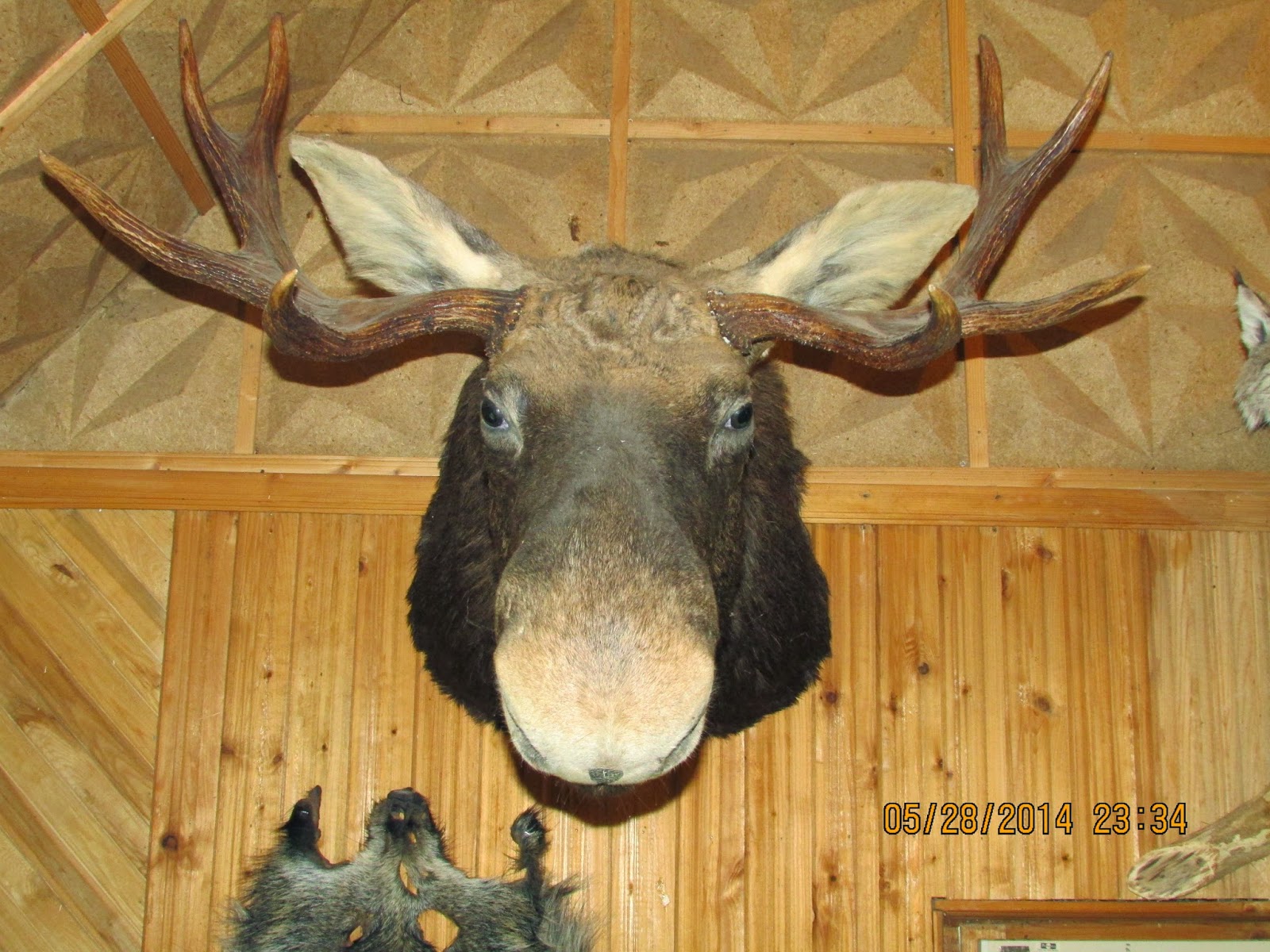
After a tour of the grounds, we repaired to Petras’s rustic guesthouse, where, for the next two hours, he plied us with moonshine, deer jerky, and wild boar bacon, all home-made.  An aspiring entrepreneur, Petras hopes to attract people to his guest house and the cottages he plans to build to capitalize on their interest in ecological issues, observing wildlife, and hunting (especially deer, but also moose, wild boar, and injured animals of whatever species).  In the main house, which is something of a taxidermy museum (see photo, below, of a lynx that was sacrificed because of a broken hind leg), scores of trophies testify to his hunting prowess.  It's important to note that his family consumes all of the game he kills.


And yes, that's a bull moose below.


Petras Adeikis is an unusually charismatic and articulate fellow.  I have no doubt that he will succeed in making Kurtuvėnai a must-see attraction on the ecotourism trail.  He ranks as one of the most interesting people--and most generous hosts--we've met so far on our Lithuanian adventure.