Tuesday, February 25, 2014

Black History Month at the Siauliai Public Library

 
Jane has been volunteering at the Siauliai Public Library, which is about a 10-minute walk from our flat on Vilniaus Street.  Her friend Roma, who is the librarian in charge of the American room, hosts an English-language circle that meets weekly and puts together events on an ad hoc basis for people interested in American culture.

Roma has been working with U.S. military officials at the nearby NATO base and the U.S. embassy to arrange a properly celebratory program in honor of Black History month.  About a hundred people were in attendance, including several African-American airmen.  The program featured a talented group of students from a music school in Vilnius. 

I had hoped to attach a link to a video, but Blogger is not letting me do so.  So you'll have to take my word for it:  it's really something to hear Lithuanian teenagers singing "Swing Low, Sweet Chariot" as part of Black History Month.

Sunday, February 23, 2014

The Hill of Crosses


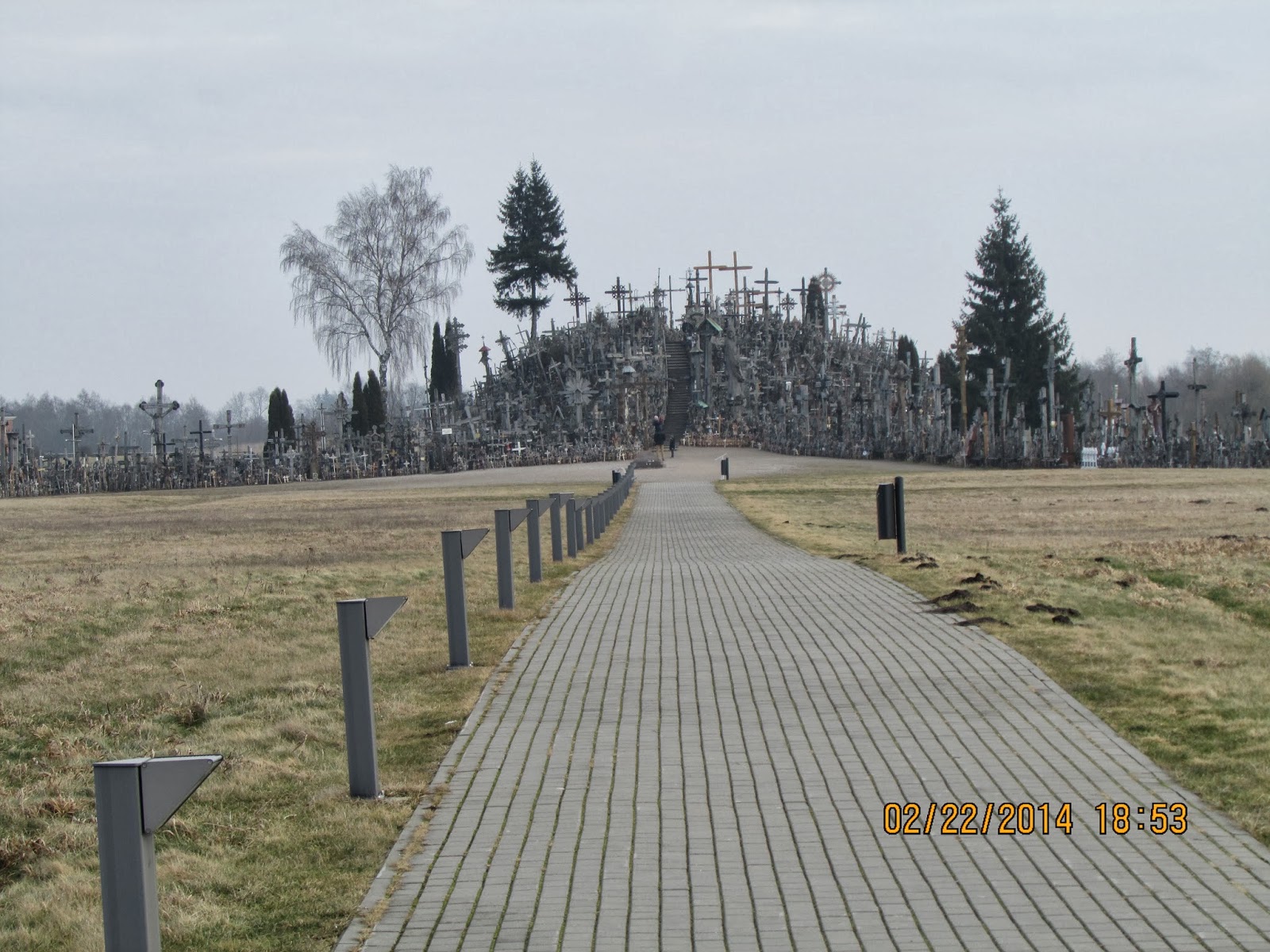
Ever since we found out that we would be spending spring semester in Šiauliai, Lithuania, we have been reading about the Hill of Crosses, a major Roman Catholic pilgrimage site that is probably Šiauliai’s best-known tourist attraction; the locals call it Kryžų kalnas.  It’s actually about 12 kilometers outside of town, so for non-motorists such as ourselves the drill involves a regional bus, and then a 25-minute hike to the site itself.  I suppose it makes sense that a pilgrimage site requires at least a little bit of walking.

The story behind the Hill of Crosses is pretty simple.  In the 19th century, the site was home to a bastion, or fort, where battles were fought during the several insurrections of Poles and Lithuanians against the Tsarist authorities.  Family members started to plant crosses to commemorate sons lost in the insurrection, and as recently as 1922 the number of crosses, according to an article in Wikitravel, was not more than 50.  By the beginning of World War II, the same source says there were maybe 400, but they didn't yet possess the kind of eloquence that they were to acquire with the post-war Soviet occupation.

What happened under the Soviets is that planting a cross on the site became a way of expressing contempt for the officially atheistic state.  Luckily, the Soviets cooperated by razing the site on at least three different occasions.  One by one, under cover of darkness, the crosses would be replaced, and now they number at least 100,000.  In 1993, Pope John Paul II visited the site, where the Polish pope left behind a characteristically modest tribute to the piety of the Lithuanian people.

As Protestants and members of the Anglican communion, Jane and I were both a little dubious about the Hill of Crosses, which struck us as having the potential to be more than a little tacky.  We have encountered kitsch at a few roadside shrines in the United States, and also at a few Roman Catholic heritage sites in Italy, and we can attest that it is no fun to be embarrassed by someone else’s cultural icon. 

As it turned out, we found the Hill of Crosses to be quite moving.  For sure, it is a photogenic site.  There is every conceivable kind of cross there, with no sense that some are more equal than others.  There is no principle of order or subordination among the crosses.  Perhaps the crosses do express the piety of the Lithuanian people, but they also seemed to us, like the “talking statues” of Rome, to be making a political statement, one that we found congenial.    

Saturday, February 22, 2014

Ukraine: The View from Baltic Avenue


On January 3, 2014, we posted a link on this blog to Tim Judah’s article in The New York Review of Books (still very much worth reading) along with a warning that events in Ukraine could have ominous repercussions in Lithuania.  Now, as we have seen over the past 48 hours, things can change abruptly, though that is no reason to assume that the highly combustible situation in Kiev is destined to have a happy ending.

But even this confirmed futilitarian is inclined to enjoy it while it lasts.  Certainly, here on Baltic Avenue we are savoring Viktor Yanukovych’s come-uppance while rejoicing in Yulia Tymoshenko’s extraordinary performance at the Maidan last night, though we compulsively worry about what the Kremlin might do following the closing ceremonies at Sochi.  

One thing is clear.  And that is that a diplomatic star has been born. 

I refer to Radoslaw Sikorski (see photo above), foreign minister of the Republic of Poland, who played a leading role in the negotiations that paved the way for dramatic political change in Ukraine—though he is quick to insist that no coup d’etat has occurred there.  Here is a link to Mr. Sikorski’s official résumé.

It is, of course, a cliché to say that we live in a small world, where there may be only six degrees of separation between Kevin Bacon and everything else.  But readers of the Washington Post will be interested to know that Mr. Sikorski is married to Post columnist Anne Applebaum, who apparently telecommutes from Warsaw.  It is, indeed, a small world (after all).


Thursday, February 20, 2014

The Money Museum in my Pocket


When we visited Vilnius last month, one of our favorite places was the money museum, which is a public education project housed in Lithuania's central bank.  Lithuanian currency is called the litas.  There are paper notes in a number of denominations, and then there are coins.  In the photo of my pocket change above, there are (top row, left to right) 5 litas, 2 litas, and 1 litas coins.  Then there is the small change (bottom row, left to right):  50 centu, 20 centu, 10 centu, 5 centu,, 2 centu, and 1 centu coins.  The litas is trading today for .40 dollars U.S., which means that the pocketful of loose change pictured above (27.25 litas) is worth about $10.83.

The interesting thing about the litas is that Lithuania is scheduled to join the Eurozone on January 1, 2015, and in anticipation of that, the value of the litas already has been pegged to the Euro, which is another way of saying that Lithuania has converted to the Euro in a manner that allows the litas a year-long victory lap.  Seems only fair.

Wednesday, February 19, 2014

Monolingualism and Its Discontents


I will acknowledge that my youth was misspent—surely more so than most.  I don’t have any illusions about that, though I don’t have that many misgivings about it, either.  It was what it was.

I do, however, have one deep and abiding regret about my squandered schoolboy days, and that is that I am living in the age of globalization without a second language.  I studied Spanish in high school, but I didn’t learn enough to place out in college, which meant that I had to take two more quarters of Español, a freshman-year fiasco from which I never fully recovered.  In graduate school, I spent a summer cramming French into a brain fatigued by a bad case of mononucleosis.  The class met every morning at 8:00.  Somehow I managed an A, but I never followed up with any more French classes.

Since then, in an effort to address my acute linguistic deficiencies, I have—for reasons related to international travel plans, for the most part—undertaken formal study of a number of other languages, including Italian, Czech, Finnish, and now Lithuanian.  Every one of them is a language in which r’s are rolled, something that I can’t do no matter how hard I try.  The sad thing is that I have never constructed a stately home, or even a shanty, on any of my carefully laid linguistic foundations.

My most frustrating experience was with Italian, which I first studied while teaching in Rome in 1975.  Upon returning to the United States, I signed up for a course offered at the Cleveland Institute of Music.  What I didn’t realize was that it was designed to serve the rather specialized needs of CIM opera students.  For me it was Verdi 101, and I was a rubber ducky in a pond full of flamboyant swans.

And so here I am once again studying a difficult foreign language more or less on principle.  My fellow students and I—there seem to be 10-12 of us, though never the same 10-12—meet on Monday and Wednesday afternoons.  The course is designed to address the needs of Erasmus students from other EU countries and a few more or less random foreigners such as myself.  I am the sole North American.  Most days, my colleagues include two Czech women, three or four South Korean students, and two guys—a Latvian and a Turk.  Our teacher, Juratė Žukauskiene (pictured above), instructs us in English, though she threatens to cut back on that over the course of the semester.

Lithuanian is one of two Baltic languages (the other is Latvian), and of the Indo-European languages Lithuanian has the distinction of being the one that bears the closest resemblance to Sanscrit.  Some Lithuanians will tell you that this reflects an essentially conservative culture. 

I must say that Lithuanian strikes me as an admirably rational language, though it starts with a fairly challenging alphabet (though mercifully not Cyrillic).  Instead of the Q, W, and X, Lithuanian uses a number of diacritical marks to create additional letters—32 in all.
 
Jane and I have been toting around a two-way dictionary and phrasebook by Jurgita Baltrušaitytė (Hippocrene Books, 2004), which has been extremely useful at the Maxima, for while the kalmarai and citrina don’t lose much in translation, we keep ending up with kiauliena (pork) when the recipe calls for jautiena (beef).  And though I may think of myself as an American, a Lithuanian will naturally regard me as a citizen of the Jungtinės Amerikos Valstijos (JAV).  Then there is the fun of recognizing familiar contents inside unusual packaging.  Earlier this week, for instance, I noticed a billboard advertising a dramatic production at a local theater:  Tenesis Vilyamsas, Iguanos Naktis.  Gradually, it dawned on me:  Tennessee Williams, Night of the Iguana. 

And so one is required to adopt a new perspective, one that’s not more or less skewed than the angle from which one ordinarily views the world, only different.  That’s all for today.  Į sveikata!


Saturday, February 15, 2014

Lindblom Link

Here (I hope) is a link that should take Siauliai University public administration students to Charles Lindblom's classic, "The Science of Muddling Through":  www.jstor.org/stable/973677

Hey, it worked for me!  Be patient.  It takes a little time to load.

In Praise of Unconventional Travel Guides


There are some standard travel guides that do a wonderful job of identifying the natural and cultural treasures that need to be seen in Lithuania.  We’ve relied on Giedrė Jankevičiūtė’s guide, a gorgeous tome in the grand style.  It’s big on cathedrals, art museums, and UNESCO world heritage sites.  Pretty much everything else is ignored.

Jankevičiūtė’s magisterial book isn’t what anyone would consider informal or quirky.  And so while it’s authoritative, it’s not nearly as much fun as Columbia J. Warren’s Experiencing Lithuania:  An Unconventional Travel Guide, which speculates on some really big cultural questions unrelated to the field of art history, such as, how big a tip should I leave in a Lithuanian restaurant?  Should I take the train to Riga, or go by bus?  Or, just what is it about Lithuanians and basketball?

Warren is a practical-minded fellow, and we have found him an amiable travel companion because he’s not inclined to over-intellectualize things.  He’s the kind of guy who would love a place like Šiauliai’s central market (see photo above), or the local chocolate museum.  Every city should have a chocolate museum.

One of the things we’ve learned from Warren is that Lithuanian cities like Siauliai are typically served by three grocery-store chains, each of which has multiple outlets in or near the city center.  They are called Maxima, Iki, and Rimi.  Our favorite is the XX Maxima on Rūdės gatvė.  It’s a bit of a hike to the eastern edge of the pedestrian district, but we don’t mind schlepping our groceries across town to get the value and selection we desire.

Unfortunately, there are still quite a few things we haven’t found in our XX Maxima.  Some are mentioned by Warren, and some aren’t.  Here are a few of the voids we’ve encountered.

1.     Canned soups and broths.  No Campbell’s, no Swanson’s, no Progresso.  Nothing packed conveniently in a can for use as the basis of various sauces.  Nothing to heat up and serve along with a grilled cheese sandwich or a nice plate of Kraft mac and cheese. . . .

2.     Kraft mac and cheese.  What do little kids eat in this country?    

3.     Kleenex.  Call it facial tissue or what-have-you, but the stuff is hard to find, and it’s expensive when you do.  The one brand we have found delivers its tissues in a psychedelic profusion of colors out of a fuschia and lime-green box.  One could, I suppose, blow one’s nose in toilet paper or something a little less abrasive, such as emery cloth.

4.     Colanders.  Is it possible that people in Lithuania don’t eat spaghetti?  On the other hand, Lithuanians certainly have discovered pica (pizza), and it is excellent.

5.     Kitchen tongs.  And so we have learned to use the tines of our forks to turn the bacon in our skillet.  

6.     Measuring cups.  Jane is learning to eyeball it, though it goes against her grain.

7.     Decaffeinated coffee.  Here, decaf seems to mean water-soluble crystals made by a food-manufacturing giant like Nestlé.  And so you can’t find a bag of ground decaffeinated coffee beans at any price in any of the grocery stores.

8.     Lithuanians seem unwilling to sacrifice good taste on the altar of good health.  There’s no skim milk or “lite” beer or anything else.  I salute them for maintaining high culinary standards, but then it makes me wonder how they’re willing to get along without Kraft mac and cheese.

9.     Night lights.  What do people in this country use in lieu of that simple little beacon that plugs into a bathroom outlet?  I guess I should have packed a flashlight.