Sunday, June 1, 2014

Kurtuvėnai, Part II


The highlight of our tour of Kurtuvėnai Regional Park was a visit with one of Vilma’s friends, Petras Adeikis (photo above).  In her 4-wheel-drive vehicle, Vilma led the way to the rustic house (see photograph, below) that Petras shares with his wife and two grown sons.  Vilma introduced him to us as an expert in wildlife management and huntsman par excellence.  It turns out that good wildlife management requires both ambitious breeding and large-scale killing.


Petras took us on a tour of his estate, explaining that he helps maintain the delicate balance of species within the park.  For instance, he has fenced off a large expanse of woods devoted to breeding lynx kittens for eventual release in the wild (it is illegal to hunt lynx in Lithuania).  We had a good look at the male and saw the female hunkered down inside an enclosure, where she was protecting her young.  He breeds several pairs of owls (see close-up of one of them, below) and cares for a pair of eaglets with broken wings.  All of the released animals are implanted with GPS chips that enable the park to follow their movements. 


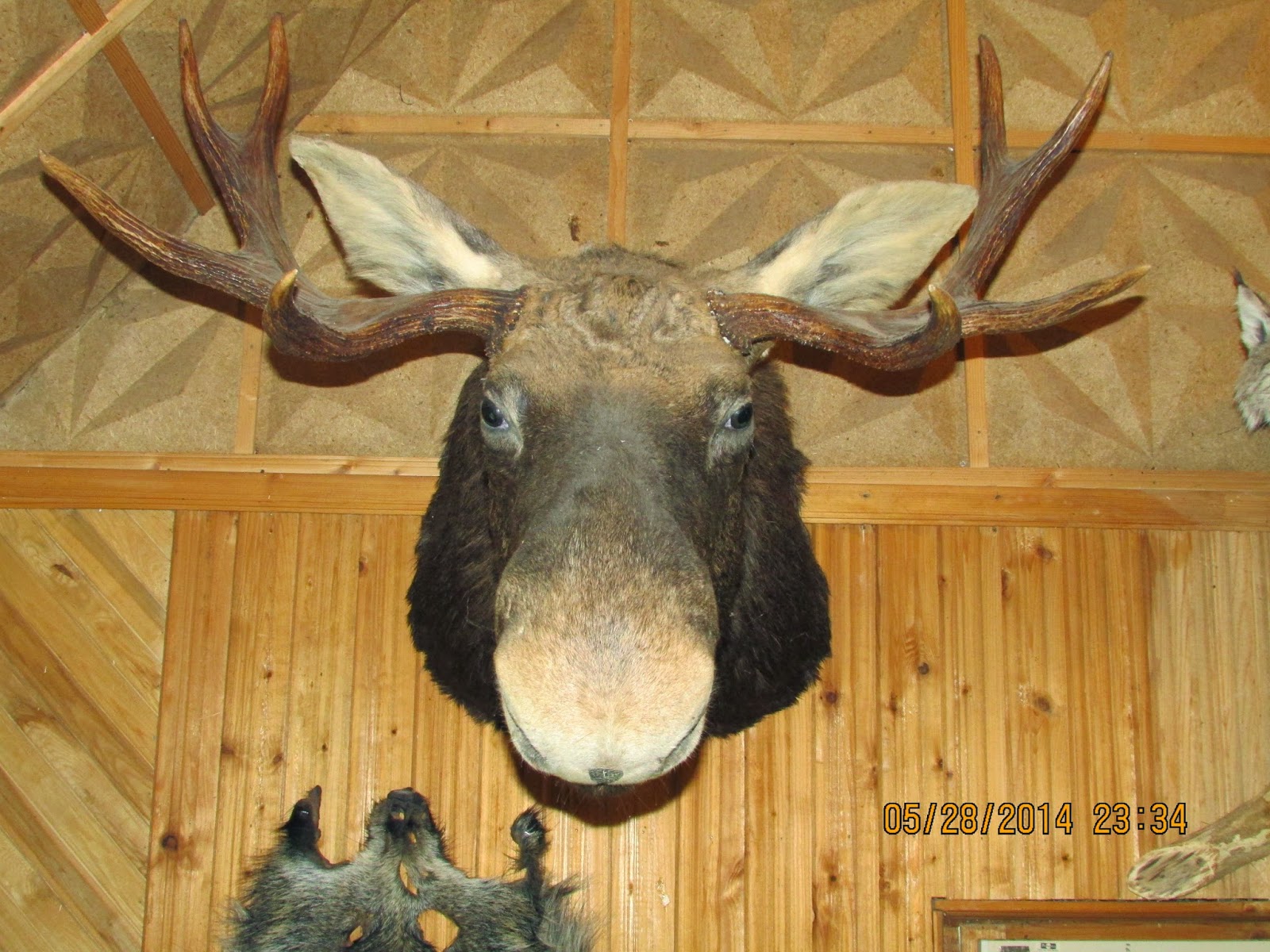
After a tour of the grounds, we repaired to Petras’s rustic guesthouse, where, for the next two hours, he plied us with moonshine, deer jerky, and wild boar bacon, all home-made.  An aspiring entrepreneur, Petras hopes to attract people to his guest house and the cottages he plans to build to capitalize on their interest in ecological issues, observing wildlife, and hunting (especially deer, but also moose, wild boar, and injured animals of whatever species).  In the main house, which is something of a taxidermy museum (see photo, below, of a lynx that was sacrificed because of a broken hind leg), scores of trophies testify to his hunting prowess.  It's important to note that his family consumes all of the game he kills.


And yes, that's a bull moose below.


Petras Adeikis is an unusually charismatic and articulate fellow.  I have no doubt that he will succeed in making Kurtuvėnai a must-see attraction on the ecotourism trail.  He ranks as one of the most interesting people--and most generous hosts--we've met so far on our Lithuanian adventure.    


Friday, May 30, 2014

Kurtuvėnai, Part I


For one reason or another—the chief one being the usual end-of-semester pressure to tie up loose ends—we have been pretty busy, which is my excuse for neglecting my duties here on Baltic Avenue.  Yesterday was a truly memorable day, however, thanks to our public administration colleague, Vilma Tubutiene, who expertly organized a field trip to Kurtuvėnai, which deserves to be reported on in full.  This is the first installment.

Vilma and her husband have a flat here in the city center, and they also have built a country house some fifteen kilometers outside the city near the Kurtuvėnai Regional Park (KRP).  One of the highlights of yesterday’s excursion was a conversation with the director of the park, Rimvydas Tamulaitis, which took place in the park’s administration building.  We were given to understand that like most of Lithuania’s regional parks, all of which date to the restoration of independence in 1992, the mission of KRP extends to both conservation of nature and human recreation.  There must be tradeoffs in such cases, and it’s not easy to get the balance just right.

What I didn’t appreciate at first was the wide variety of wildlife that exists within the boundaries of the park, which is quite large (over 17,000 hectares, most of it heavily forested) and the extent of the park’s resourcefulness in protecting numerous species of endangered flora and fauna.  Park administrators also must be commended for their skill in securing outside funding for their various conservation programs and outreach efforts.  Photo #1 above shows the park director posing for the camera with our group (from left to right, front row:  Jane Kolson, Arwiphawee Srithongrung of Wichita State University, Vilma Tubutiene, Oksana Mejere, and Jurgita Mikolaityte; back row: Ken Kolson, Ken Kriz of Wichita State University, and park administrator Rimvydas Tamulaitis).

The Kurtuvėnai Regional Park is on the site of a former estate, one that had the usual amenities, including a manor house, a barn, a carriage house, stables, and a brewery on site, not to mention a nearby church that was generously supported by the local squire.  One thing we have learned in the course of this semester is that Lithuanian preservationists and conservationists are less timid than their counterparts in the U.S. about reconstructing buildings that were destroyed.  Negotiating a compromise between architectural aesthetics and historical authenticity doesn’t seem to bother Lithuanian preservationists, perhaps because so much of their built environment was destroyed by the wars and strife of the twentieth century.  What they call “restoration” often is simply reconstruction.  Whether  we realize it or not, Americans have had the luxury of being a little squeamish about these kinds of issues.


There is a carriage house that is in the process of being reconstructed.  While it is a handsome building, it completely lacks the patina of old age.  The same thing is true of the barn, or granary.  Because so many of the buildings are reconstructions, the structure that appealed most to me was the brick stable (see photo #2, above), which has room for 40 horses.  We walked through the stable.  Most of the horses appear to be thoroughbreds, though there also are a few workhorses (see photo #3, below).

 
The mansion at Kurtuvėnai was rebuilt at least five times over four centuries or so.  Early in the twentieth century, the estate was owned by a family named Plater.  The mansion was destroyed in the Russian civil war following World War I.  Soviet nationalization and the deportations to Siberia following World War II ruined the Plater family once and for all, and the estate became a collective farm, or kolkhoz.  It seems to have been the residents of the kolkhoz who ransacked the manor house in the late 1950s.
 
 
Nearby is a church, Saint Jacob the Apostle, which has a long history extending back to the 17th century (see photo above; yes that's my bride under the yellow umbrella).  Like most of the other buildings in the village, the church looked to me--despite the baroque bell towers--like a 19th-century construction; at any rate, it is not the palimpsest that one might reasonably expect of such a venerable building.
 

Wednesday, May 21, 2014

The A-Team


Diana, the Roman goddess of the hunt, is said to have been able to talk to and control wild animals.  Her Lithuanian namesake, Diana Saparniene, appears to exert similar powers as chairperson of the public administration department at Šiauliai University.  Here she is shown with some of her acolytes at Arkos Restoranas in the city center.  From left to right:  Jurgita Mikolaityte; Ken Kriz, Wichita State University; Arwiphawee Srithongrung, Wichita State University; Diana Saparniene; Jane Kolson, George Washington University; Ken Kolson, The Ohio State University; Oksana Mejere; and Anzelika Gumuliauskine.   


Monday, May 19, 2014

Khrushchyvoka


One of the more frustrating things about international travel is the way you notice distinctive features of the foreign environment at first, then slowly learn to take them for granted.  For example, I have become inured to two prominent features of the Lithuanian built environment.

Both involve Soviet-era concrete, which is nearly ubiquitous in Šiauliai, and can be seen anywhere just by bothering to look at what's under your feet.  Soviet-era pavers (see photo above) have not aged well.  Similarly, reinforced concrete stairs (see photo below) are pock-marked, and frequently have steel rods sticking out at odd angles.  Columbia Warren, author of the unconventional travel guide we carry with us, says that Lithuanians just aren't as litigious as Americans.  We see the opportunity for lucrative liability claims here; apparently, they don't. 


Then there are the Soviet-era apartment blocks, typically 5-9 stories high. If you’ve seen one, you’ve seen them all, which is why I haven't gotten around to photographing any of them yet.  The photo below will, therefore, have to serve as an archetype.  This one is faced with brick, as are many of the apartment blocks here in Siauliai, but  you can be sure that reinforced concrete lies just beneath the surface. 


It turns out that these apartment buildings have a name.  They're called khrushchyvoka, a reference to Nikita Khrushchev, who was party chief in Moscow when they came into vogue.  They were supposed to exploit the structural properties of reinforced concrete and prefabrication.  It didn’t take them long to metastasize and spread into every nook and cranny of the Soviet Union.   There must be millions of them at this point.

Our experience--limited though it may be--tells us that many of the flats inside these buildings have been renovated by the residents and are quite lovely.  Our suspicion is that the owners of the apartment blocks themselves, whoever they may be, have little or no incentive to make improvements to the entry ways, lobbies, staircases, and other public areas inside these buildings.  Click here to read the Wikipedia entry on khrushchyvoka
 

Saturday, May 17, 2014

The Curonian Spit


 UNESCO’s World Heritage program is an exemplary case of international collaboration in pursuit of a larger—in this case, global—public good.  The list of World Heritage sites includes both natural and cultural treasures, and at this point it consists of close to 1,000 sites around the world—from the Pyramids of Giza to the Great Wall of China, from Yosemite National Park to the Leaning Tower of Pisa—that constitute the most splendid works of Divine Providence and mere mortals.  Some of these natural and/or cultural treasures are secure, while others (44 sites ranging from the Everglades to virtually every World Heritage site in Syria) are very much in danger of being lost forever. 

Four of UNESCO's world heritage sites are located, at least in part, in Lithuania: 

·        Vilnius Historic Centre, an example of a central European town that evolved organically over five centuries;

·        Kernavė Archaeological Park, a site that documents the remarkable encounter between Pagan and Christian funeral traditions;

·        Struve Geodetic Arc, a chain of survey triangulations stretching from Hammerfest in Norway to the Black Sea, carried out in the early 19th century by the astronomer Friedrich Georg Wilhelm Struve, and constituting the first accurate measuring of a long segment of a meridian; and

·        the Curonian Spit, a 60-mile long sand dune peninsula separating the Baltic Sea from a lagoon shared by Lithuania and the Russian Federation’s exclave of Kaliningrad. 

At the top of this post is a map of the Curonian Spit, which is a little reminiscent of the Florida Keys or the Outer Banks of North Carolina, except that it’s more than just barrier islands, in that it more definitively cuts the ocean off from a fresh-water lagoon.  Jane and I were very fortunate to have been shown around the spit by our Lithuanian friends, Laima and Jonas (see photo, below).  


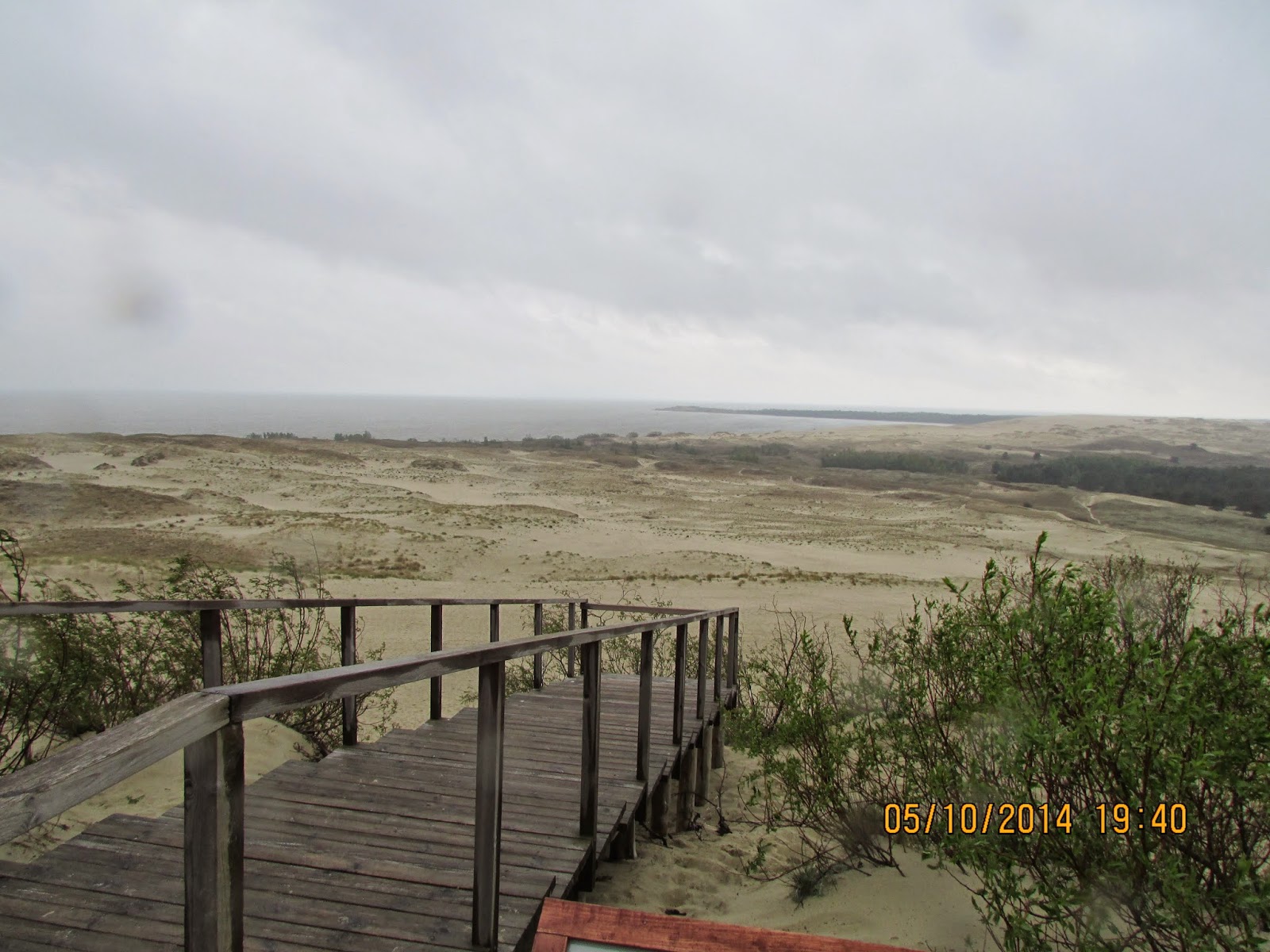
When one thinks of the Curonian Spit, one thinks immediately of sand dunes, such as the ones in the photo below, which was taken from the top of a dune near the town of Nida (see map, above; Thomas Mann used to have a place in Nida).  Those are Russian waters (lagoon side) visible in the distance.


But much of the Spit consists of deep pine and birch forest, and so is home to wild creatures large and small, including cormorants, boar, and moose.  That’s right, moose (see photo below).  Honestly, I thought it was a donkey at first.  The absence of antlers means that it's a cow, i.e., a female moose.  


The Spit, finally, is home to a large colony of wooden sculptures that celebrate the mysteries of pre-Christian Baltic culture (see photo below).  These extraordinary images are part of an outdoor museum called Witches Hill, in the northern part of the Spit.


Wednesday, May 14, 2014

Palanga


Klaipeda is a seaport, but it is not a beach town.  Luckily, it’s a cheap and easy bus ride to Palanga, a resort community of some 17,000 souls that is very popular with Russians (among others in this part of the world).  There’s a reason why Klaipeda doesn’t have a beach, and we’ll get into that in a subsequent post.
 
The main attraction in Palanga is the beach (see photo above), and it is easily accessible from all parts of the city, which offers almost every kind of vacation housing—from summer cottages to upscale hotel rooms and everything in between.  There are attractive bike trails, and acres of parkland, including a vast botanical garden on the grounds of which sits a stunning palazzo (formerly the Feliks Tyszkiewicz manor, and serving later as the headquarters for Soviet border guards) that now houses an archaeological amber museum (see photo #2, below).

 
Amber is formed over millions of years from the resin produced by a kind of pine tree that is now extinct—in part because a super-resinous tree proved unsuitable to an altered climate.  Anyway, amber is beautiful (see photo #3, below), and it is soft enough to be easily worked.  While it can be mined, there always is a chance that a big gob of it will wash up underfoot, which makes it worth keeping your head down on a Baltic beach.

 
One of the best things about the amber museum is that it has an extensive exhibit on "inclusions," which refers to the random flora and fauna trapped in the resin millions of years ago and encased in amber for eternity.  Remember the premise of Jurassic Park, in which the mosquito that has just dined on the back of a dinosaur gets entangled in amber, and so becomes the source of T-Rex DNA?  That mosquito was an "inclusion."
 
What use, you might ask, was made of such a bourgeois and frivolous substance as amber during the fifty years of Soviet occupation?  It’s hard to say for sure that the wives of the commissars were not attracted to amber, but the artifact in photo #4 is almost certainly closer to the official version of Soviet history.


Tuesday, May 13, 2014

Presidential Election in Lithuania


At last count, there were 37 political parties registered with the Ministry of Justice in Lithuania.  That makes the politics of this small country--there are only 3 million people living here--fairly complicated.  Plus, they have a popularly elected president in addition to a parliament and prime minister. 

The results of last Sunday's preliminary presidential election are in, and incumbent president Dalia Grybauskaite garnered 46% of the vote, not enough to preempt a runoff election pitting her against the #2 candidate, Zigmantas Balcytis, a social democrat.  The run-off is scheduled for May 25. 

Grybauskaite, a former EU budget commissioner and a black-belt in karate, is an ex-communist who has earned a reputation for harboring no illusions about Soviet expansionism as it pertains to the Baltic states.  She's also a Ph.D. who did post-doctoral work at Georgetown University's School of Foreign Service in 1990, around the time the U.S.S.R. was dissolving.  Click here to read the recent story about her in the Guardian